Thursday, June 30, 2011

22

Well, turning 22 was a lot different than turning 21.

I suppose for one thing, I forgot it was my birthday when I woke up on Sunday morning until Mom wished me a very happy birthday, and I thought "oh, that's right!" as I gave her a big hug. No monumental legal status attained.

Mom and Dad flew in for the weekend after visiting Alston and Nick in Boulder and spending some time with them in Taos and Santa Fe, New Mexico. I had such a wonderful time with them, showing them around Dallas, wining and dining etc. On Friday night we went to an incredible steakhouse, Pappas Bros., which was enjoyable in every sense of the word. The steak was perfectly cooked, the wine delicious, and it was just so great to see my parents after being in unfamiliar territory for awhile.

On Saturday morning we drove over to the Farmers' Market to get some fresh veggies for dinner. I think I might have eaten a whole tomato just from trying all of the offered samples from the different farms.

The Dallas Farmers' Market

On the way to lunch we stumbled upon Pioneer Plaza, which I had not yet seen. There is a magnificent bronze sculpture in the park called "Cattle Drive" with cast cowboys and bulls running lifelike through the square. Amazingly, the huge sculpture was all done by one man, Robert Summers.

Part of "Cattle Drive" in Pioneer Plaza, downtown Dallas
In the afternoon I showed them the DMA which they really enjoyed, though I think I may have walked their socks off. I just kept thinking of different exhibits that I wanted to show them! I'm glad they have an idea now of the amazing place where I work. That night we cooked our farmers' market veggies with "Bible study chicken," one of my favorite recipes from home.

On Sunday (my birthday) we went to church, which happened to be their birthday-acknowledgement Sunday, and went to the Garden Cafe for brunch. Then we drove out to Arlington to see the Dallas Cowboys Stadium. It is one incredible building. One of the girls at work described it as "the Mothership." It's not a far off description, as it does resemble a spaceship that could be in Star Trek.

Dallas Cowboys Stadium

We then drove around the campus of SMU and I showed them the Calatrava kinetic sculpture, "Wave," outside of the Meadows Museum.

Calatrava's "Wave," Meadows Museum, SMU

Then we wandered around North Park Mall which puts Atlanta's Lennox to shame.

We ate dinner at a place called Javier's which boasts authentic and gourmet Mexican cuisine. I was a little bit nervous that Mom and Dad wouldn't like it, because I know usual Mexican restaurants aren't their thing, but Javier's was amazing. I haven't had Mexican like that since Cabo. I think we each had a tenderloin, but prepared differently. Again the wine was great, and they brought me a slice of rich chocolate pie with a birthday candle.

It was a wonderful weekend with great food, great wine, and of course, the most wonderful parents ever. Thanks for the great time. Momma and Daddy, I love you.

Know Your Own History

Sorry I haven't written in so long! Last week was busy, cleaning up and working before Mom and Dad arrived for the weekend! I have some lovely downtime since we don't have any events for a couple of weeks. Besides, I am home anyway because I caught some nasty cold bug that another intern brought into the pit. My boss told me to get better so it doesn't spread to the rest of the office. So here I am, sitting in my bed snuffling, surrounded by tissues and typing lethargically like Meg Ryan in "You've Got Mail."

Since Tom Hanks isn't going to barge in here and try to make me feel better, I can update everyone on the past week!

Our last event was last Tuesday, featuring S.C. Gwynne and his novel Empire of the Summer Moon, a book about the Comanche Indians, their prime and decline. It follows the story of Cynthia Ann Parker, a young pioneer girl who was abducted by Comanches. She eventually married a powerful chief and her son, Quanah, was one of the last great Comanche leaders. The book was a finalist for the National Book Critics Award as well as the Pulitzer Prize.


S.C. Gwynne, a writer for Texas Monthly and now well-known author, is actually from the northeast. Wearing his cowboy boots onstage, he reflected on the "Wow!" factor of being a Yankee new to this immense state of Texas and what he termed "generational memory." In the north, he explained, the Indians had been subdued long before his forefathers. For his generation, there is no memory of Native Americans in the north, only textbook passages. There are no more frontier origins in the north, he said. Texas on the other hand, is still very much a pioneer state. Stories about Indians are not extracted from textbooks here, rather, they are told by those with immediate memory. Native Americans here are a part of the somewhat recent past compared to the citizens of the northeast. Texans should be proud of their generational memory and frontier origins and should take every opportunity to visit those places that remain monuments to that history.

The Comanche nation expanded to about 2,400 square miles of the American West. That is an enormous plot of territory that we wouldn't expect to belong to an Indian tribe. This wasn't just the general area where the Comanches hunted buffalo. This was their empire: militarily organized and defended. And, boy, were they defended.


When the Spaniards brought horses to the Americas, the Comanches too full advantage of this new species. They learned breeding techniques. The Comanches were clever and calculating. They knew that with horses they could hunt buffalo more efficiently and feed the tribe, they could fight wars ruthlessly for protection and conquest. This union of the Comanche tribe with the horse made them the dominant Indian nation in the west.


The Comanche Indians were divided into bands from 1,000 to 5,000 people, often according to family allegiances. Comanche men had a very Romantic freedom and social flexibility. The ability to recruit a war party increased social status. These war bands made Spanish presence in the west "irrelevant," as it struck terror into these European men.

One of S.C. Gwynne's readers during a book-signing thanked him for the "Hey Honey" book. When he asked what that meant, she said that while reading it, she frequently turned to her husband, saying, "Hey honey, did you know....?"

A member of our audience, in fact, a great-great-great...grandson of Quanah Parker, himself questioned Gwynne on the validity of his research methods. Most of Gwynne's research came from archival sources and documents. The man in the audience insisted that this research contradicted his interest in generational memory and immediate stories from the past. He wondered why Gwynne didn't interview any Comanche Indian relatives for information for his book. Snidely, he spat that Gwynne probably thought they didn't know their own history. A large amount of Q & A time had been usurped by this slight altercation, however, the man did have a point. Some primary source interviews would have been a suitable way to enhance the novel, however, Gwynne is an accomplished writer who can write his own book his own way. Evidently, the other night was not the first time these two have met.

Anyway, it was a very interesting way to end the evening for sure, and I am looking forward to reading this book!

Sunday, June 19, 2011

Mr. Opportunity

There's something like a line of gold thread running through a man's words when he talks to his daughter, and gradually over the years it gets to be long enough for you to pick up in your hands and weave into a cloth that feels like love itself. 
 ~John Gregory Brown


Last week, my friend Joyce accidentally blogged an early Happy Father's Day note. Terrified and embarrassed, I immediately set to drafting this blog before I realized that she had made a mistake. Thank goodness it was a mistake, because to neglect Father's day for my dad would be undeniably egregious.

Picking out a Christmas tree, 2010

My father is the greatest man in my life. The man who has been my supporting keystone and who has made all of my dreams possible. Like a broken record you have encouraged my to "take advantage of all the opportunities." That ceaselessly repeated phrase has become a vital necessity to my daily life. Without you there would be significantly fewer opportunities available. To you, Daddy, I dedicate my work ethic, my stamina, and  the fruition of all of my opportunities.

Salmon fishing in Alaska, summer 2007


Thank you for giving me ample opportunities that have been my privilege to take.


I love you, Daddy.

North Carolina Thanksgiving, 2010

A Lesson in Subtraction

"The true poem is the daily paper."
 ~Walt Whitman


Friday night was my first Late Night at the DMA. It was a fun, buzzing atmosphere with hundreds of people of all ages at the museum for bedtime stories, art workshops, and a free concert by The Polyphonic Spree.

"The art doesn't go home, why should you?"


Arts & Letters Live hosted poet Austin Kleon who gave a presentation about his creative process and published collection of poems, Newspaper Blackout. Austin is such a nice guy who just stumbled across his style as a struggling college graduate attempting to write. His poetic method has been very well-received by young artists and writers everywhere, through the omnipotence and omnipresence of the internet and guess what, blogs!  It was my great privilege as an intern to give the introduction for Austin Kleon, so I thought I'd just re-write my speech here.

Newspaper Blackout by Austin Kleon

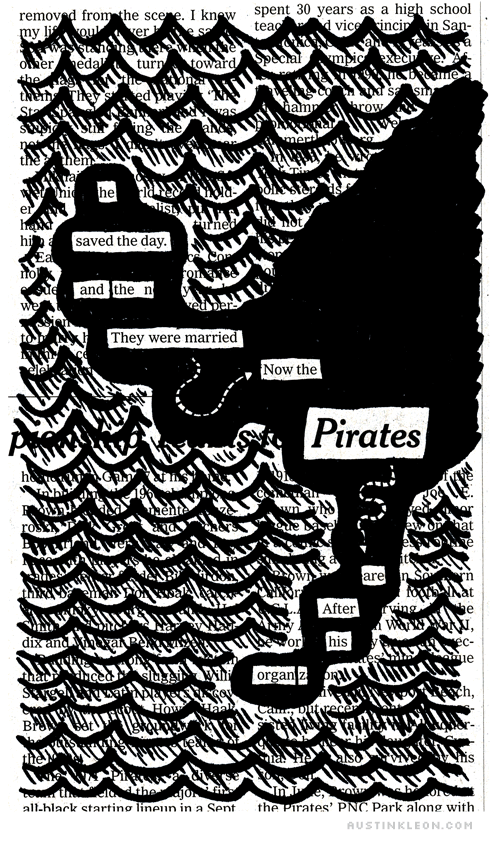
Austin Kleon is an innovative artist, extending poetry beyond the literary genre and into the visual. Crossing out words in a newspaper began as a way to relieve writer's block; however, the amusing messages adn hip design that resulted have been received with enthusiasm from aspiring artists and poets everywhere. The New Yorker says, "[The poems] resurrect the newspaper when everyone else is declaring it dead...like a cross between magnetic refrigerator poetry and enigmatic ransom notes, funny and zen-like, [his poems are] collages of found art..." Austin honed a simple hobby into a progound artistic paradox: creation through destruction. He excavates and polishes clever, penetrating diction, forming his own thought-provoking statements, then buries the remaining mass of text in darkness. Cleveland Plain Dealer compares Kleon's creative process to that of an artistic master, saying that he is "sort of like Michelangelo carving away the marble that imprisoned what he saw within." 

"Pirate's Booty," Austin Kleon

Austin's work has a special appeal that resonates with all audiences. In newspapers he uncovers the tenderness of family, the awkwardness of adolescence, and Texan identity, all garnished with refreshing whimsy and imagination. He certainly uncovers the fun in literature. Please welcome Austin Kleon. 

Austin just takes a newspaper article, finds the words he likes, connects them into a sort of poem or story and then blacks out the rest of the article with a Sharpie. Some question his technique, wondering if he just usurps the work of journalists to call it his own art. In his presentation, however, Austin was very clear that he pays little attention to the actual substance of the article, but more to the present diction in order to create his own piece from the existing work. The more subtraction he does from the article, the more the art is his own. He compared himself to Igor Stravinsky, a composer who loved classical music so much that he took the sheet music for multiple classical ballets and edited it according to his own desire to create something new.

Austin explained the artistic process of imitating role models and influential persons. It is in our failure to adequately represent them that our own quirks and personalities emerge in our artwork and writing. On his powerpoint he included this video by Clement Valla who experimented the evolution of a single copied line. Valla asked 500 people to trace a single line. Each person only traced the line that preceded their own (if that makes any sense?) Watch what happened:


So, you see how in an effort to imitate our predecessors, we create something new and unique to our own self. Some may call this stealing, however, if this is the case, there are few artists who do not steal. In fact, the book on which Kleon is currently working is entitled Steal Like an Artist. What he does is not plagiarism, rather fair use, and reinterpretation.

Kleon is only the most recent of generations of people who have manipulated the newspaper. Creative ideas for recycling newspapers date back all the way to Caleb Whitefoord, Benjamin Franklin's neighbor, in the 18th century. instead of reading newspaper columns top to bottom, he read them straight across, many resulting in humorous jokes and phrases. Here are some:

"Notwithstanding the present exorbitant price of candles—Some dark transactions will soon be brought to light."


"Wanted to take care of an elderly Gentlewoman—an active young man just come out of the country."


"Last night a most terrible fire broke out—and the evening concluded with great festivity."


Whitefoord's humor, as well as the poetry of Dadaist Tristan Tzara, and "beat" author William S. Burrough's are prototypes of Kleon's avant-garde work that has now gone viral. 


On his website, Austin encourages people from all over the world to create their own blackout poems and submit them to newspaperblackout.com. From the daily submissions, Kleon selects one for display on the website. 


Austin's charisma was a pleasure to have at the Dallas Museum of Art for our Late Night and the following day for a Young Writers Workshop. He had us all trying our hand at newspaper blackout, which believe me, is MUCH harder than it looks! Give it a shot!


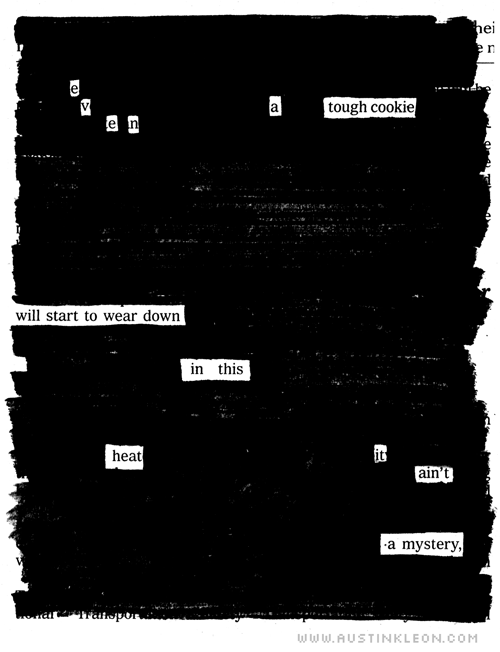
Here's one of my favorites that particularly applies to my current circumstance: 
"Summer in Texas," Austin Kleon

Visit www.AustinKleon.com for more information and updates about him and his work!

The Spanish Exhibition


"Color
           is
                       Light"
                                                ~ Esteban Vicente

Last Friday I had the morning off so I ventured over to the Meadows Museum on the campus of Southern Methodist University. The museum has an incredible collection of Spanish art that the Prado would itch to get its hands on. Actually, it was the goal of founder Algur H. Meadows to establish a pequeñito Prado in Texas. The goal has become realized in the Meadows Museum's three year partnership with the grand Spanish institution. With this alliance, the Museums will exchange two graduate student interns for an incredible opportunity in the curatorial field at an international level. With its collection and educational opportunities, the museum is truly a gem that Dallas is very lucky to have.

The first thing that is noticeable about the Meadows Museum before you even enter it, is the sound. As I was getting out of my car, the sound of metallic screeching and creaking reached my ears before I even turned to walk toward the building. Wondering what in the world needed so much grease, I came upon a fantastic undulant, kinetic sculpture by contemporary Spanish architect and sculptor Santiago Calatrava. Calatrava is easily recognized by his very linear style that is oftentimes arranged to produce very curvilinear effects.

Santiago Calatrava, Gare do Oriente, Lisbon, Portugal

His sculpture, "Waves," outside of the Meadows Museum is much more modest in appearance, though perhaps more dissonant in sound:


Like it? I happen to love it. For a more thorough description see this video by SMU and Meadows Museum director Mark Roglán:


Once inside the museum it is very quiet and elegant with ornately framed pieces and a large curved staircase in the entrance hall. The museum is full of Spanish medieval and Renaissance art including portraits of saints by artists like El Greco and Ribera, as well as impressive altarpieces by unknown artists. There is also a lovely collection by Spanish impressionist, Joaquín Sorolla, who I love. We went to his museum in Madrid that is preserved to resemble his home and studio. He is most known for his quaint beach paintings. 

I couldn't find any pictures of the pieces in the Meadows collection, but here's my favorite painting from el Museo Sorolla in Madrid:
Joaquín Sorolla, "Niña entrando en el baño"
Currently, there is a wonderful exhibition of abstract impressionist Esteban Vicente. He was in the same school of painting as Mark Rothko, Jackson Pollack, and Robert Motherwell, all of whom I like because they maintain thought-provoking meaning and skill in their work without crossing the border into the inexplicably bizarre art of the contemporary period.  Vicente loves color in his work. He went through a monochromatic phase early in his career with a palate similar to that of Jackson Pollack, however he is most known for his vibrant collages like "Labels," and abstract paintings like "Collage No. 3." 


Esteban Vicente, "Labels"


Esteban Vicente, "Collage No. 3"

The visit to the Meadows Museum reminded me of how much I love Spanish art and how underrated it is. One always hears of French impressionists, van Gogh, Monet, Degas, etc., but hardly anyone knows who Joaquín Sorolla is. I had never heard of Esteban Vicente until my visit, and he is now on my list of favorite painters along with Pollack and Rothko.

The morning passed quickly and I had to leave one museum to go to work at another!

Monday, June 13, 2011

The Weight of Pencils

Well, it has been a harangue getting my internet up and running, and even after spending ALL DAY LONG waiting for the AT&T man to fix it, it is still not the speed that I am technically paying for. So, I have the immense pleasure of hosting yet another AT&T man in my home tomorrow evening. So MAYBE I can finally watch the season finales of Modern Family and Glee. There is, however, enough internet signal for me to update my blog! So here goes.

Last Saturday was the first annual BooksmART Festival hosted by Arts & Letters Live and boy, was it a success! The museum was crawling with infants, toddlers, and young teenagers all running back and forth between story times, author presentations, illustration workshops, and of course the book-signing tent. We had to have extra volunteers on stroller parking patrol. The week leading up to the festival was full of volunteer training, sign making, and logistical meetings. A lot of thought was channeled into the rotational schedule of the event, how to arrange the stage and speakers for the performers, and of course, where to unload the five vans of faeries that would be arriving in time for their afternoon performance. It was wonderful to see all of our extremely hard work pay off in such an energetic day.

A poster for the BooksmART Festival

My particular task that day was to escort one of our participating authors around the museum to his various stations. Duncan Tonatiuh (Doon-cahn Toe-na-tee-oo, phonetically speaking) is particularly notable for his work as an author and an illustrator at the very young age of 26. He was born in San Miguel de Allende in Mexico and even now spends half of the year there and the other half in New York City. He has his life cleverly arranged to outsmart winter. 

Author/Illustrator Duncan Tonatiuh


I went to go pick up Duncan at his hotel near Lovefield Airport. Gripping my iPhone the whole way, I was relying completely on my Google Maps app and praying that I didn't get lost. It was after all, the first time I had ventured away from Central Expressway, Henderson, or Mockingbird. I finally collected my author, who is much smaller and younger looking than in that picture, and frantically apologized for my iPhone (which had just crashed) and that I was not quite sure how to get us to the museum. Fortunately, I have a decent internal compass and found my way back to Lemmon Avenue which took me back to Central and my comfort zone. 

Once we arrived at the museum we were whisked away to the green room for tea and coffee before heading to the Latin American galleries for Duncan's first story time. Duncan's latest story is a picture book about young muralist Diego Rivera and how he would see our world today. Appropriately, Helen, the consultant for Arts & Letters Live, placed us right next to a Diego Rivera self-portrait on the fourth floor. 

He did another story time downstairs in C3 (Center for Creative Connections) during which he drew for the children, letting them choose the subject for the picture. The masterpiece du jour was "Carlos Riding a Pony." 

Duncan also gave a presentation about the inspiration for his work which was very interesting. His illustrative style derives from the Mixtec tradition of ancient Mexico, with characters in profile and round figures. It is very flat and two-dimensional just like the codices written by scribes of ancient Latin America. 

A Mixtec codex
A page from Tonatiuh's picture book, Dear Primo


Duncan was frequently asked what his next project is. He is currently working on a rendition of Little Red Ridinghood in which the wolf is replaced with a coyote and the whole story takes place in the borderlands of Texas and Mexico. Though it is primarily a picture book for children there will be political and social undertones that adults will certainly be able to grasp. It should be published next fall.

We ate lunch in the green room, accompanied by Caldecott Medalists David Weisner and Jerry Pinckney, who were delightful to listen to. (Note, the Caldecott Medal is a prestigious award for illustration). Weisner shared his ideas for an upcoming graphic novel while Pinckney explained his process for watercolor workshops.

"Jerry, I have an immensely important question for you," stated Mr. Weisner.

"Now what is that?" Inquired Mr. Pinckney.

"I have long admired and observed your work, but tell me, what weight pencil do you use?" queried Mr. Weisner, seriously. 

Jerry Pinckney uses a .2 weight pencil, if I remember correctly. He also explained more about his process and medium, which David Weisner absorbed very intently. The whole conversation was a most humorous and endearing vignette of these wonderful artists.

During our short breaks I showed Duncan around the museum. He particularly enjoyed the exhibit of ancient art of the Americas, including Peru, Mexico, and North America. I tried to give him a more extensive tour but ended up getting us lost somewhere in between Indonesian art and Japanese art. Tell you what, the DMA is one museum I would hate to be trapped in.

Our final station for the day was the book-signing tent outside in Ross Plaza. It was quite toasty, but fortunately we were only there for 45 minutes. Rick Riordan, author of consecutive NYTimes Bestselling series, was outside for the entire afternoon. The line for his table wrapped around half of the DMA circumference. Duncan's last name, Tonatiuh, has indigenous roots meaning "sun god." Every time he signs a book he says: "Enjoy this LIBRO, from your AMIGO, Duncan Tonatiuh," with a Mixtec sun next to it. 

At 3:45 I escorted Duncan to his town car which would transport him to the airport. He asked me to send him the picture we took in the book-signing tent, so somehow I'll figure out how to get that to him. And then he went. My author-friend-for-the-day was gone and after so much running around and chaos, I was free to go home! 

Duncan Tonatiuh and me in the book-signing tent

Up next: A weekend with innovative poet Austin Kleon.


Wednesday, June 8, 2011

An Evening with the Illustrious David McCullough

"I see little of more importance to the future of our country and our civilization than full recognition of the place of the artist. If art is to nourish the roots of our culture, society must set the artist free to follow his vision wherever it takes him...I look forward to an America which will reward achievement in the arts as we reward achievement in business or statecraft...And I look forward to an America which commands respect throughout the world, not only for its strength but for its civilization as well."

~John F. Kennedy, words delivered at Amherst College in 1963

Many times over the past few months I have been thanking God and work ethic that I landed the internship at Arts & Letters Live. Never have I been so thrilled, however, as I was this evening, sitting in the third row of over one thousand chairs in the ballroom of the lovely Fairmont Hotel in downtown Dallas. The event? A presentation by renowned and laudable writer and historian David McCullough about his latest book, The Greater Journey. It was the pleasure of Arts & Letters Live to host the event along with the World Affairs Council.


McCullough has been awarded multiple honors for his many works that capture the details and nuances of American history. He has received two Pulitzer Prizes, for his novels Truman and John Adams. Two times is enough of a charm, for he has also received the National Book Award twice for his novels The Path Between the Seas and Mornings on Horseback. To crown his already golden achievements, he was awarded the Presidential Medal of Freedom-- the highest civilian award in America.

Award-winning author David McCullough


His novel The Greater Journey traces the lives and influence of Americans who have journeyed to and explored Paris. His speech this evening, contradicted any negative attitude toward this elegant country and absolutely abolished under-appreciation for its history and hidden close ties with the United States.

McCullough's latest novel, The Greater Journey


Let's consider.

Without the help of French general Rochambeau, we could not have withstood against the British for the entirety of our American Revolution.

Our nation's capitol, Washington, D.C., was designed by Pierre Charles L'Enfant. You may have guessed, but in case you didn't, he happened to be French.

The United States acquired a major portion of its territory in the Louisiana Purchase from a little man named Napoleon. Also French.

One of the greatest documentaries of the American democracy was written by a man named Alexis de Tocqueville. He was very French and actually did not speak a lick of English when he came to explore our unfamiliar lands.

There are more American soldiers buried in France than in any other country besides our own. French land is memorialized in our history. It is sacred.

And let us never forget our monument of American affirmation. The symbol of our freedom and democracy. The Statue of Liberty, was itself designed by a Frenchman named Bartholi, and given to the United States by the people of France.

Needless to say, France and the United States are connected in astoundingly obvious ways, though as modern citizens we tend to forget the amiable ties between us in the history books.

In his speech, McCullough described the appeal of illustrious institutions such as the University of Sorbonne for aspiring Americans in a country that was starved of decent higher education. There were barely any American universities for the arts, medicine, etc.

Consider Charles Sumner. You may not know who he is unless you are a history buff or perhaps an ashamed South Carolinian. Sumner became a student at Sorbonne, where he noticed that black people were treated the same way he was and had the same agenda and ambition. It was then, in Paris, that he came to the realization that in America, black people were treated as inferior because of the social constructs in that country. Blacks were in no way inferior "naturally," as it was believed. His revelation led him to become one of the greatest and most eloquent abolitionists in America in later years. His voice was so powerful, in fact, that conservative statesman Preston Brooks, from, guess where, South Carolina, nearly beat him to death on the floor of the Senate. It was nothing Washington had ever seen nor will again.

Samuel Morse also journeyed to Paris to become a painter. Well, he slightly detoured when he created the telegraph system which he brought home to America. This is one of the greatest inventions the world has ever seen. Also in his time in Paris, Morse became acquainted with a gentleman named Louis Daguerre, the creator of the daguerreotype. The daguerreotype was the earliest form of photography. Morse also brought this invention home to America. When it came to monumental inventions, Morse did not pack light.

American Artists who developed their skills in Paris include George Healy, famous portraitist for such persons as Abraham Lincoln, Augustus Saint-Gaudens, a sculptor of monuments such as Sherman and Victory in Central Park, the prodigy John Singer Sargent, and the lovely impressionist Mary Cassatt.

Those of literary prestige include James Fenimore Cooper, author of The Last of the Mohicans, Ralph Waldo Emerson, Nathaniel Hawthorne, Mark Twain, and Henry James.

Every single one of these names and more found innovation, skill, and artistry which they brought home to help polish our own distinctly American culture and pride. Our own American civilization.

Kudos to David McCullough, then, for writing a chronicle of French-American influence and harmony and illuminating such a dimly focused subject of the relationship of these countries.

Musee du Louvre, Paris, France


The examples listed in this blog were extracted from McCullough's speech at the Fairmont Hotel, Dallas, TX, June 8, 2011.

Tuesday, June 7, 2011

"First Tuesday"

Hi again from Texas!

Sorry I didn't write over the weekend. It was a good one-- I picked up "The Red Pyramid" by Rick Riordan and couldn't put it down. I finished it last night, 500 pages in 2 days...don't think that beat my Harry Potter record, but still close! I also tried to visit the Meadows Museum, but it was closing in an hour so I decided to come back another time.

Saturday night I met up with a sorority sister of mine who graduated three years ago. We went to dinner with a bunch of Sewanee fellas and then hit a couple of bars, where I also met some of her friends who went to Texas Tech. It was a lot of fun, and it was refreshing to hitch a semblance of a social life onto my awesome "career exploration."

The beautiful blown glass sculpture by Dale Chihuly in the Atrium

In the past two days at work, I have been spread-sheeting even more relentlessly than usual. In addition to logging short story submissions for our Texas Bound literature series, I have been recording survey responses that patrons have completed after our programs. Approximately 180 rows and 16 columns later, I have learned that our patrons are generally Caucasian seniors with very handsome annual salaries. But I suppose that is not really a surprise. Little handwritten notes in the margins of these surveys have thrown me into fits of giggles as one disgruntled patron (>66 years of age) complained: "My car got locked in the parking garage when my friends and I went out for cocktails after Arts & Letters Live!!" My apologies, Betty White. Next time, buy the garage attendant a drink. Surely, he wouldn't trap your car then. I even had one lady write "American" as her ethnicity. I wonder what she was assuming...So I was actually quite enjoying myself, squinting at indecipherable cursive handwriting requesting that Oprah and Nicholas Sparks be asked to speak at one of our programs. Wow, and blegh!

This morning, I had a scheduled tour of all of the galleries in the museum which proved to be quite helpful as the building itself keeps unfurling into more and more galleries and nooks. It was also the first Tuesday of the month, which means free entry and dozens and dozens of chilluns' running around, slipping and sliding down the slick concourse. Oh, be careful where you step because if a kid doesn't bowl into you, a stroller will on its way to "Stroller Parking" outside of the Center for Creative Connections (C3). Hence, the chaos that simultaneously excites and disturb tour guides and docents on our renowned "First Tuesdays."

Please call this number if your stroller is towed: 214-555-KIDZ

The DMA has a very extensive collection of art, ranging from primitive Indonesian art to 19th century European. There is also the Reves collection, donated by Wendy and Emery Reves. Wendy was a socialite and fashion model and her husband, Emery, was a writer, publisher, and art collector. They gave their whole collection to the DMA under the stipulation that the exhibit be reconstructed in the likeness of their villa in southern France. A villa, that before them, was owned by *ahem* Coco Chanel. So, in the middle of our eastern art collection, welcome to the ravishing Reves home, abounding in European impressionist works including Manet and Degas, and also boasting Vincent van Gogh's "Sheaves of Wheat." There are also multiple studies of Lautrec paintings, and the study for van Gogh's "Terrace at Night." In a room as small as an afterthought is a collection of paintings by Winston Churchill (including a self-portrait sketch of a pig), his telegrams to the Reves, and a box of cigars, hand-rolled for him in Cuba. Just a shrug of a room as if to say, "yeah, we're besties with Winston. No big deal."

We completed the tour and headed back up to the offices, weaving amongst ecstatic children and frazzled moms along the way. "Hands down, Jimmy. Jimmy. JIMMY! I DON'T WANT YOU EVEN CLOSE TO THAT PAINTING!" That's right Jimmy, no fingerprints on our Frederic Church painting. "The Icebergs" is kind of a big deal.

Frederic Church's "The Icebergs"

Back upstairs again, I was asked to translate a survey for our BooksmART Festival into Spanish. Bilingual utilization part 1. Part II happens on Saturday as I escort illustrator Duncan Tonatiuh around the museum as he reads stories and lectures in English and Spanish. Planted in my chair, I opened up WordReference.com for any stray words I couldn't remember, like "bookmark" and set to work! It was actually pretty fun to recall phrases and vocabulary and remind myself that I can understand Spanish. It certainly was not as discouraging as a ten page research paper on the theme of "movement" in the work of women writers of early modern Spain.

Tomorrow I am helping out with a program featuring David McCullough, whom we are hosting is association with the World Affairs Council. McCullough is a writer historian and a two-time winner of the Pulitzer Prize. I'm looking forward to hearing him lecture tomorrow evening. Friday is Late Night which means the museum is open till midnight, followed by the first ever BooksmART Festival! So, at Arts & Letters Live we are gearing up for quite a busy week, and looking forward to heaving a refreshing sigh of relief when it's over. Hopefully, seamlessly and successfully over.

Love from Dallas!

"People often ask me if I'm working on a book. That's not how I feel. I feel like I work in a book. It's like putting myself under a spell. And this spell, if you will, is so real to me that if I have to leave my work for a few days, I have to work myself back into the spell when I come back. It's almost like hypnosis."
 ~David McCullough

Thursday, June 2, 2011

Revamping Mythology-- Researching Rick Riordan

“Being a lifelong learner is a lot more than taking a standardized test. It means being curious about things. It means having questions that don’t always have answers…" ~Rick Riordan

My post today is something along the lines of propaganda in the sense that I will not be summarizing my activities today (which involved programming meetings and more spreadsheets) but rather elaborating on a particular project of great interest to me. So I thought I'd share.

On June 11, Arts & Letters Live is thrilled to present our first BooksmART Festival at the DMA. This day-long event will feature many well-known authors and illustrators of children's literature and provides the community with an opportunity of working with these creative minds and learning from them. Part of my job in preparation for this event is to research some of our guests to help prepare staff members for their introductions. Honestly, I cannot think of a more enjoyable job. I spent my morning reading excerpts from young adult novels, watching their movie trailers, and finding book reviews. It was heaven. Today I had the great pleasure of discovering Rick Riordan.

Perhaps I have been living under a rock for the past decade, but I have never heard of Mr. Riordan, who evidently is quite famous, after the popularity of his young adult adventure series Percy Jackson and the Olympians skyrocketed upon publication of the first book, "The Lightning Thief."


 Has anyone heard of this series?? In it, Riordan brings ancient Greek mythology into the modern day world with a modern day middle schooler hero. It is up to Percy Jackson, an ADHD/dyslexic middle schooler to defend America from terrorizing Greek gods. Some may say it's a sort of rip-off of Harry Potter, but in my opinion, as there are no witches and wizards there is no plagiarism, and kids obviously love more presence in the fantasy genre. Why is that? In an interview on his website (www.rickriordan.com) Riordan says: “It’s easier to read about people doing amazing things like casting spells and riding dragons than about people doing mundane things like going to school. Kids already know that life. It’s nice to pretend you are someone else once in a while.” Riordan should know what kids are looking for these days as he was a middle school English teacher before he became a full-time writer. Guess what he taught in his English classes? Yep, Greek mythology. Why? Because the myths are always fascinating stories! I remember receiving my copy of D'Aulaire's Greek myths and not being able to put it down till my brain devoured the contents. Though the Percy Jackson series is intended for middle grade readers, I am excited to pick up a new book that will have me as entranced as Rowling's Harry Potter. Well, maybe as entranced...


Oh, and it's already been made into a movie...


The series Riordan is presenting at the BooksmART Festival involves Egyptian gods and goddesses and hieroglyphics. It's called The Kane Chronicles. The second book, "The Throne of Fire" just came out May 3rd. The first book, if anyone is interested, is called "The Red Pyramid."


The best part about these novels? The amount of influence that kids had over them. The Percy Jackson series began as a bedtime story! Riordan ran out of myths to tell his son, who insisted, then, that his father make up one. Thus, Riordan brought the fantastic classical stories into our world. It was his son who encouraged him to put it all into a book. His son, by the way, was diagnosed with ADHD and dyslexia, and thereby inspired him to make the protagonist thus also. The idea is that learning differences should not be shameful, but rather a "badge of honor." The first readers of Riordan's manuscript was his middle school class-- fifth period, right after lunch. TOUGH. But, they loved it! They gave him suggestions for the title, for the way Percy Jackson's sword works etc. Much of the enthusiasm and soul of the work comes from the kids in Riordan's life.

Here I am, writing as though I've read the novels. After researching so much today, I feel like I have! As soon as I finish Jane Eyre I'm going to pick up a copy of "The Red Pyramid."

For all the adults out there, he has a mystery series for us too! It's called Tres Navarre and takes place in Texas. I'd like to read these books as well.

All of my information on Riordan came from his website found at this link.

Still loving Dallas. But not as much as I love y'all :)

Wednesday, June 1, 2011

Settling In

Today was a rather productive day at the museum for me.

First of all, I was finally allowed into the DMA's underground parking garage which is very brightly color-coded-- ha, art museum, go figure. After climbing four flights of stairs I found myself at the simple white entrance decorated only by a contemporary statue in the courtyard and a blazingly colorful mural depicting the heavens and the elements.


First on the agenda was an operations meeting with Hayley in which members from all the departments sit around a table and discuss the upcoming couple of weeks and the events in store. This is to prevent any clashing "trainwrecks," or conflicting events, among the various departments.

Later in the morning I was taught how to access the Texas Bound email account so that I could accept submissions for the series and notify the authors that we received their work. Texas Bound is a series that, in short, hosts "Texas-connected actors bringing stories by Texas-connected authors from the page to the stage." Along with these presentations, Texan bands and musical guests are invited to perform at the museum. It is a series rich with regional identity and interest. Right now we are accepting short story submissions for this series in the fall. I am fortunate enough as an intern to be on the selection committee with Katie, Head of Arts & Letters, and Hayley, the Audience Coordinator.

After I responded to all of the authors, I began arranging their names and works in a spreadsheet that will help us easily recall details once we begin the selection process.

My new home in the intern pit!


I had to defer my organizing, however, as it was time for my first Gallery Talk! I wandered on down to the concourse and stood next to the visitors desk holding my ostentatiously orange sign reading TOUR for all to see. Shortly the "regulars" start trickling in, museum members who come to the gallery talks about every week. This week they came to hear DMA curator Carol Robbins gave a presentation on the Thaw Collection of American India Art that is visiting from the Fenimore Art Museum in Cooperstown, NY. The talk was rather long and discursive, understandably, for there was so much material that it would be impossible to constrict the lecture to a mere 45 minutes. There are so many gorgeous pieces to add to my "Items Coveted" list from all the museums I've visited around the world, and I can't wait to come back with Mom and Dad!


After the Gallery Talk I went back up to my desk in the intern pit only to find that Dan, the elusive IT man, had finally come to install my email and reset my desktop to be my own! Yay! The only downside was that he erased the previous desktop which held my spreadsheet of Texas Bound submissions on which I had concentrated so hard. No worries, however, cause that meant I had a task for the whole afternoon! Aren't spreadsheets fun??


OH! I also accidentally introduced myself as "Rhett" today though I'm going by "Isabella" this summer to try it out. Hayley gave me a very confused glance and I awkwardly stammered out an explanation for my alternate identity. Whoops.

Looking forward to afternoon meetings all day tomorrow. Must be thinking of creative ideas for more adult programming activities!

Love from the Big D!