"The true poem is the daily paper."
~Walt Whitman
~Walt Whitman
Friday night was my first Late Night at the DMA. It was a fun, buzzing atmosphere with hundreds of people of all ages at the museum for bedtime stories, art workshops, and a free concert by The Polyphonic Spree.
 |
| "The art doesn't go home, why should you?" |
Arts & Letters Live hosted poet Austin Kleon who gave a presentation about his creative process and published collection of poems, Newspaper Blackout. Austin is such a nice guy who just stumbled across his style as a struggling college graduate attempting to write. His poetic method has been very well-received by young artists and writers everywhere, through the omnipotence and omnipresence of the internet and guess what, blogs! It was my great privilege as an intern to give the introduction for Austin Kleon, so I thought I'd just re-write my speech here.
 |
| Newspaper Blackout by Austin Kleon |
Austin Kleon is an innovative artist, extending poetry beyond the literary genre and into the visual. Crossing out words in a newspaper began as a way to relieve writer's block; however, the amusing messages adn hip design that resulted have been received with enthusiasm from aspiring artists and poets everywhere. The New Yorker says, "[The poems] resurrect the newspaper when everyone else is declaring it dead...like a cross between magnetic refrigerator poetry and enigmatic ransom notes, funny and zen-like, [his poems are] collages of found art..." Austin honed a simple hobby into a progound artistic paradox: creation through destruction. He excavates and polishes clever, penetrating diction, forming his own thought-provoking statements, then buries the remaining mass of text in darkness. Cleveland Plain Dealer compares Kleon's creative process to that of an artistic master, saying that he is "sort of like Michelangelo carving away the marble that imprisoned what he saw within."
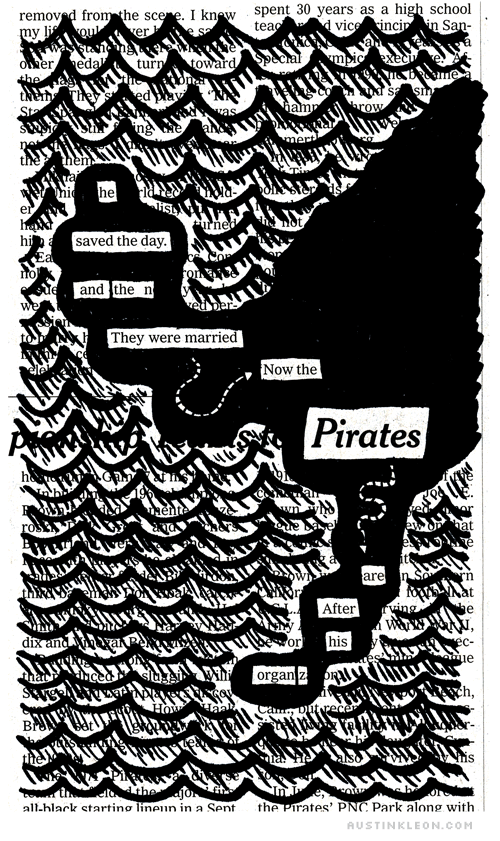 |
| "Pirate's Booty," Austin Kleon |
Austin's work has a special appeal that resonates with all audiences. In newspapers he uncovers the tenderness of family, the awkwardness of adolescence, and Texan identity, all garnished with refreshing whimsy and imagination. He certainly uncovers the fun in literature. Please welcome Austin Kleon.
Austin just takes a newspaper article, finds the words he likes, connects them into a sort of poem or story and then blacks out the rest of the article with a Sharpie. Some question his technique, wondering if he just usurps the work of journalists to call it his own art. In his presentation, however, Austin was very clear that he pays little attention to the actual substance of the article, but more to the present diction in order to create his own piece from the existing work. The more subtraction he does from the article, the more the art is his own. He compared himself to Igor Stravinsky, a composer who loved classical music so much that he took the sheet music for multiple classical ballets and edited it according to his own desire to create something new.
Austin explained the artistic process of imitating role models and influential persons. It is in our failure to adequately represent them that our own quirks and personalities emerge in our artwork and writing. On his powerpoint he included this video by Clement Valla who experimented the evolution of a single copied line. Valla asked 500 people to trace a single line. Each person only traced the line that preceded their own (if that makes any sense?) Watch what happened:
So, you see how in an effort to imitate our predecessors, we create something new and unique to our own self. Some may call this stealing, however, if this is the case, there are few artists who do not steal. In fact, the book on which Kleon is currently working is entitled Steal Like an Artist. What he does is not plagiarism, rather fair use, and reinterpretation.
Kleon is only the most recent of generations of people who have manipulated the newspaper. Creative ideas for recycling newspapers date back all the way to Caleb Whitefoord, Benjamin Franklin's neighbor, in the 18th century. instead of reading newspaper columns top to bottom, he read them straight across, many resulting in humorous jokes and phrases. Here are some:
"Notwithstanding the present exorbitant price of candles—Some dark transactions will soon be brought to light."
"Wanted to take care of an elderly Gentlewoman—an active young man just come out of the country."
"Last night a most terrible fire broke out—and the evening concluded with great festivity."
Whitefoord's humor, as well as the poetry of Dadaist Tristan Tzara, and "beat" author William S. Burrough's are prototypes of Kleon's avant-garde work that has now gone viral.
On his website, Austin encourages people from all over the world to create their own blackout poems and submit them to newspaperblackout.com. From the daily submissions, Kleon selects one for display on the website.
Austin's charisma was a pleasure to have at the Dallas Museum of Art for our Late Night and the following day for a Young Writers Workshop. He had us all trying our hand at newspaper blackout, which believe me, is MUCH harder than it looks! Give it a shot!
Here's one of my favorites that particularly applies to my current circumstance:
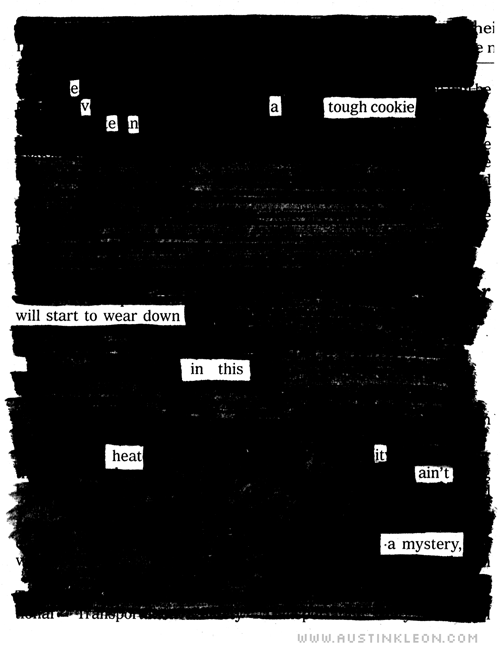 |
| "Summer in Texas," Austin Kleon |


No comments:
Post a Comment